- Social Media
- Content Strategy
How to Create a Social Media Content Strategy That Supports Your Business Goals
A goal-first framework for social content: auditing what works, SMART goals, audience and platform choice, content pillars, calendars and the KPIs that prove impact.
- Published
- September 19, 2026
- Reading time
- 14 min read · 2,992 words
- Focus keyword:
- social media content strategy
A successful social media content strategy connects every piece of content to a clear business purpose. Instead of posting simply to stay active, brands should start with a measurable business goal, identify what their target audience needs and then choose the content pillars, formats and KPIs that support that goal. The potential audience is enormous: DataReportal reports 5.66 billion active social media user identities worldwide in 2026, equivalent to 68.7% of the global population. But reach alone does not create business value. A strong content strategy for social media marketing answers four questions early: Who are we trying to reach? What should we publish? Which platforms matter? And how will we measure whether the content contributes to business results?
What Is a Social Media Content Strategy & Why Does It Matter?
A social media content strategy is a documented plan that defines what a brand publishes, who the content targets, where it appears and how it supports measurable business goals. If you are asking what is a content strategy, think of it as the framework behind your content decisions rather than the individual posts themselves. A broader social media strategy can include goals, channel selection, paid campaigns, community management and resources, while the content strategy focuses on topics, messaging, formats, content pillars and publishing priorities. A content calendar then turns that strategy into a schedule. This distinction matters because posting three times per week does not constitute a strategy by itself. Effective content strategy for social media explains why each topic deserves resources and what outcome the business expects it to support.
How Can a Social Media Content Strategy Support Business Goals?
The simplest way to connect social activity with business performance is to follow one chain:
Business Goal → Social Media Goal → Content → KPI
A company trying to build brand awareness needs different content and metrics from a company trying to generate qualified sales leads. HubSpot's 2026 research highlights the challenge: 69% of social teams report increasing pressure to prove ROI, while platform restrictions, inadequate tools and multi-touch attribution continue to make measurement difficult. Therefore, choose your social media KPIs after defining the business objective rather than tracking every available metric. Reach can indicate awareness, for example, but it cannot tell you whether a lead-generation campaign produced qualified prospects or revenue.
| Business Goal | Social Media Goal | Suitable Content | Primary KPI |
|---|---|---|---|
| Brand awareness | Reach new audiences | Short-form video, educational posts | Reach, impressions |
| Website growth | Drive qualified traffic | Guides, carousels, link posts | Clicks, CTR |
| Lead generation | Capture prospects | Webinars, case studies, lead magnets | Leads, CPL |
| Sales | Support purchase decisions | Demos, comparisons, testimonials | Conversions, revenue |
| Customer loyalty | Strengthen relationships | UGC, community content, support posts | Engagement, retention |
How Do You Audit Your Current Social Media Content Strategy?
Before creating a social media content strategy, review what already works. Analyze at least the previous three to six months of content so short-term fluctuations do not dominate your conclusions. Compare your strongest and weakest posts by reach, impressions, saves, shares, comments, link clicks and conversions. Then group the posts by platform, format and content pillar to reveal patterns. For example, your educational LinkedIn carousels may generate fewer impressions than short videos but twice as many qualified website visits.
Include a competitor analysis, but do not simply copy high-performing posts. Look for topics competitors repeatedly cover, content formats their audiences engage with and questions nobody answers properly.
A structured social media audit gives you evidence for future decisions instead of relying on assumptions about what your audience wants.
How To Set Goals for a Social Media Content Strategy
Every goal in your social media content strategy should support a measurable business objective.
Use SMART goals – Specific, Measurable, Achievable, Relevant and Time-bound – to replace vague ambitions with targets your team can evaluate. "Increase LinkedIn traffic" gives you little direction. "Increase qualified website sessions from LinkedIn from 1,000 to 1,300 per month by December 31" defines a 30% target, a channel and a deadline.
Limit each objective to one to three primary metrics so your reporting stays focused:
- For awareness, track metrics such as reach and impressions
- For traffic, monitor clicks and click-through rate
- Lead-generation campaigns should prioritize qualified leads and cost per lead
- Sales campaigns should measure conversion rate or attributable revenue
These social media goals create the bridge between content activity and business outcomes.
Defining the Target Audience for Your Social Media Content Strategy
Demographics alone rarely provide enough information to build relevant social media content ideas. Define your target audience by combining demographic data with needs, motivations, pain points, buying triggers, objections and platform behavior.
Use social media analytics, customer surveys, CRM data, reviews, comments and social listening instead of relying entirely on assumptions.
Then consider where each audience segment sits in the customer journey. Someone who has never heard of your company may need educational content that explains a problem, while a prospect comparing suppliers may benefit more from case studies, product demonstrations or customer testimonials.
Build simple audience personas around these differences. Sprout Social's 2026 research surveyed more than 2,300 consumers and 1,200 marketers and found that consumer expectations differ significantly between networks, reinforcing the need to understand both audience and context.
How to Choose the Right Platforms for Your Social Media Content Strategy
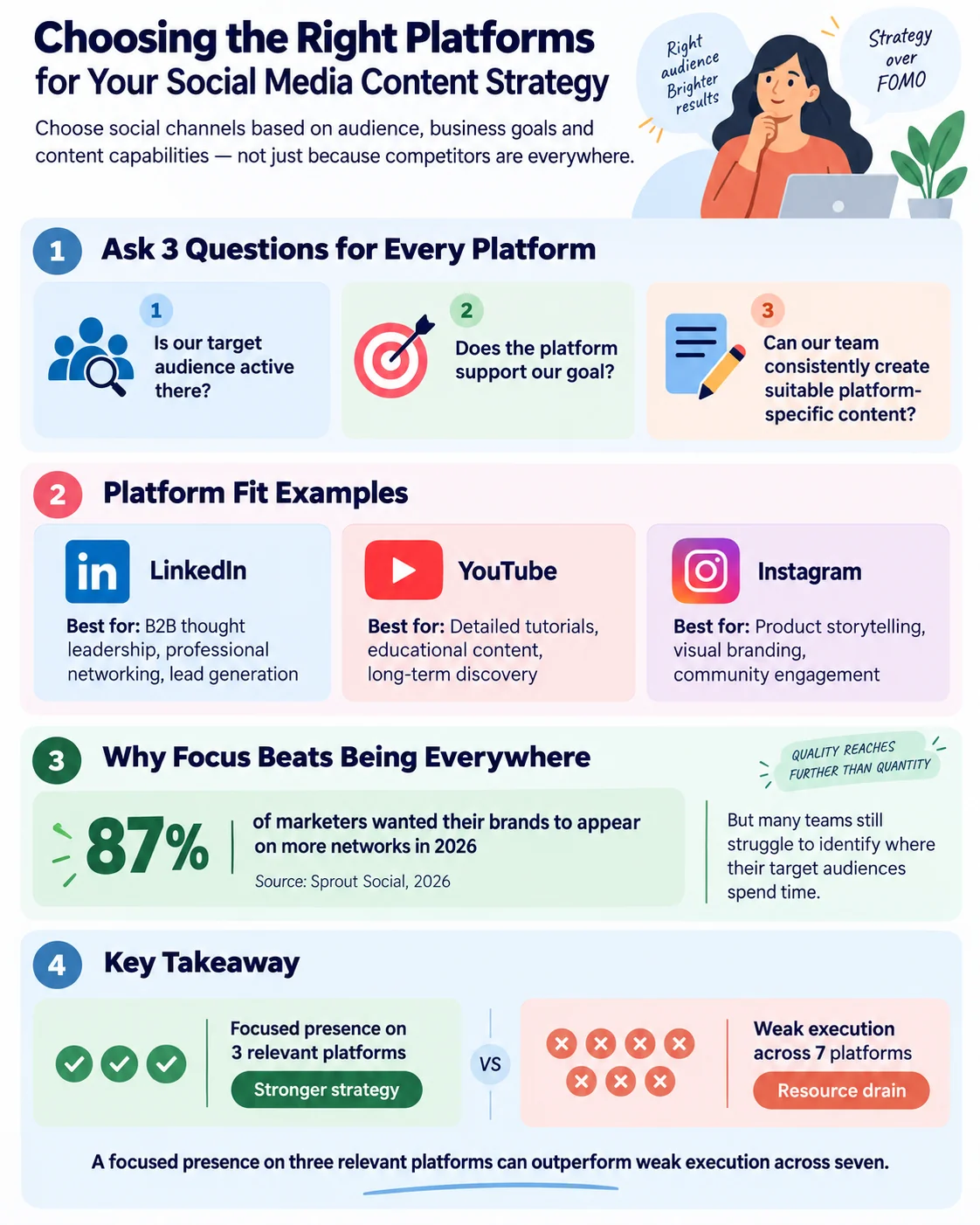
Choose social channels according to your audience, business goals and content capabilities, not because competitors maintain accounts everywhere. Ask three questions for every platform:
- Is our target audience active there?
- Does the network support our goal?
- Can our team consistently create suitable platform-specific content?
A B2B software company may prioritize LinkedIn for thought leadership and lead generation, while YouTube supports detailed tutorials and long-term discovery. A visually driven consumer brand may find Instagram more useful for product storytelling and community engagement.
How to Build Content Pillars for a Social Media Content Strategy
Content pillars turn broad business objectives into repeatable themes. Most brands can start with three to five content pillars, a range Sprout Social recommends to maintain variety without diluting the brand message.
A B2B software company might use Education, Thought Leadership, Product Use Cases, Social Proof and Community as five pillars. Each pillar should answer three questions: What audience need does this address? Which business goal does it support? What should someone do after consuming the content?
Education can build awareness and trust, while case studies and customer stories provide social proof during consideration. Product demonstrations can support conversion. Useful pillars also make brainstorming social media content ideas easier because teams no longer start with a blank page. They generate ideas within strategically defined themes.
Turning a Social Media Content Strategy Into a Content Calendar
A social media content calendar translates strategy into daily execution. At minimum, record the publication date, platform, content pillar, topic, format, CTA, campaign, owner, production status and primary KPI for each planned post.
Start by adding fixed events such as product launches, conferences or seasonal campaigns, then build evergreen educational and community content around them.
Use content repurposing to increase the return on high-effort assets. One 45-minute webinar, for example, could become a YouTube video, three short-form clips, a LinkedIn carousel, several quote posts and an FAQ post.
Avoid treating publishing frequency as a universal rule. A team that can sustainably produce three high-quality posts per week should not publish seven weak posts simply to satisfy an arbitrary schedule. Your posting schedule should match available resources, audience behavior and content quality.
How Do You Measure & Improve a Social Media Content Strategy?
Measure your social media content strategy against the objective you defined at the beginning rather than using likes as a universal scorecard. Analyze results monthly and compare content by pillar, topic, format, platform, hook and CTA.
A post that generates 50,000 impressions but zero meaningful clicks may perform well for awareness but poorly for lead generation. Conversely, a niche LinkedIn post with 4,000 impressions and 30 qualified website visits could create greater business value.
Look for patterns across several posts rather than changing strategy after one weak result. Effective social media analytics should help you decide what to repeat, improve, stop or test next.
| Goal | Useful KPIs |
|---|---|
| Awareness | Reach, impressions, audience growth |
| Engagement | Comments, saves, shares, engagement rate |
| Traffic | Link clicks, CTR, website sessions |
| Lead generation | Qualified leads, CPL |
| Sales | Conversion rate, attributed revenue |
What Does a Social Media Strategy Example Look Like?
Consider a B2B software company that wants to generate 150 qualified demo requests per quarter. Its target audience consists of marketing managers at companies with 20 to 200 employees. Instead of posting everywhere, the company prioritizes LinkedIn and YouTube.
Its social media strategy example could allocate 35% of planned content to education, 25% to thought leadership, 20% to case studies and social proof, and 20% to product use cases.
LinkedIn CTR, qualified landing-page sessions, marketing-qualified leads and demo requests become the primary KPIs.
Each content type serves a different customer-journey stage: educational posts create awareness, expert commentary builds authority, case studies reduce uncertainty and product demonstrations support conversion.
This approach shows how a content strategy for social media marketing can connect everyday posts to measurable business growth.
Which Social Media Content Ideas Support Different Business Goals?
The best social media content ideas depend on what you want users to do. Short-form video can support reach, but brands should not use it simply because the format is popular.
HubSpot reports that 48.6% of marketers rank short-form video among their top three media formats for ROI in 2026, while 44% of B2B brands now use it for content such as demonstrations, testimonials and quick tips.
Match formats to objectives instead of forcing every message into the same trend. Educational carousels can establish expertise, user-generated content can increase trust, and comparison posts can help prospects make purchase decisions. A balanced content mix should move people through different stages of the customer journey.
| Business Goal | Content Ideas |
|---|---|
| Awareness | Short-form videos, educational posts, trend commentary |
| Authority | Research insights, expert opinions, thought leadership |
| Trust | UGC, testimonials, employee stories |
| Engagement | Polls, questions, community discussions |
| Leads | Webinars, checklists, downloadable guides |
| Sales | Demos, case studies, product comparisons |
Mistakes That Can Weaken a Social Media Content Strategy
A weak social media content strategy usually fails because execution becomes disconnected from purpose. Posting frequently without a business goal creates activity, not necessarily results. Tracking only followers and likes can hide whether content influences traffic, leads or revenue. Publishing identical posts across every network also ignores platform-specific behavior.
Avoid making every post promotional, following trends that do not fit your brand voice, or expanding onto new platforms without resources to manage them properly. Also avoid ignoring comments, messages and social listening.
A social presence works best as a two-way relationship: useful publishing attracts attention, but community engagement builds the trust that turns that attention into long-term value.
How Often Should You Review Your Social Media Content Strategy?
Monitor content continuously, analyze results monthly and conduct a broader strategic review at least once per quarter.
Weekly monitoring can identify unusual performance, customer questions and emerging topics. Monthly reviews should compare content performance, platforms, formats, content pillars, engagement, traffic and conversions. A quarterly review gives you enough information to reconsider goals, platform priorities, target audiences and resource allocation.
Do not rebuild your social media content strategy every time one post underperforms. Individual results fluctuate because of timing, news cycles, distribution and audience behavior. Look for repeated patterns across multiple posts and campaigns.
Content pillars are not permanent either: Sprout Social recommends revisiting them as the business and audience evolve. The purpose of regular reviews is continuous improvement rather than constant strategic reinvention.
What Are the Most Common Questions About a Social Media Content Strategy?
What Is a Social Media Content Strategy?
A social media content strategy defines what your business will publish on social platforms, who the content should reach, why you are creating it and how you will measure success. It usually includes business-aligned goals, target audiences, platform priorities, three to five content pillars, preferred formats, brand messaging, publishing processes and relevant KPIs. It differs from a social media content calendar, which primarily organizes when individual posts will go live. If you are researching what is a social media strategy, think of the wider strategy as the overall framework for your social presence and the content strategy as the section that governs what you communicate. Both should ultimately support measurable business objectives rather than social media activity for its own sake.
How Do You Create a Social Media Content Strategy?
If you want to know how to create a social media content strategy, start with data rather than post ideas. First, audit three to six months of existing content and identify your strongest topics, formats and platforms. Second, define SMART social media goals that connect to business objectives. Third, document your target audience, customer journey and platform behavior. Choose the channels where you can realistically reach that audience, then create three to five repeatable content pillars. Turn those pillars into a social media content calendar and assign appropriate formats and CTAs. Finally, monitor social media KPIs such as reach, CTR, qualified leads and conversions.
What Is the Difference Between a Social Media Strategy & a Content Strategy?
A social media strategy defines the overall approach your business takes to social platforms, while a content strategy focuses specifically on the information and creative assets you publish. The broader strategy can cover business goals, target audiences, platform selection, paid media, community management, customer service, resources and measurement. The content strategy for social media defines topics, content pillars, brand voice, formats and messaging. A third component, the content calendar, organizes individual posts by date and channel. In simple terms, the social strategy explains where and why your business participates, the content strategy explains what and how you communicate, and the calendar explains when you publish it. Keeping those three levels separate prevents tactical publishing decisions from replacing genuine strategy.
What Is the 5-5-5 Rule for Social Media?
The 5-5-5 rule for social media is an informal engagement framework rather than an official rule from Instagram, LinkedIn, TikTok or another platform. Importantly, marketers use several different versions. One common interpretation recommends performing five actions in each of three engagement categories, for example, liking five relevant posts, leaving five meaningful comments and responding to or starting five conversations each day. Other versions use different combinations of original content, curated content and engagement. The useful principle is consistency and two-way participation, not the exact number five. Treat the 5-5-5 approach as a simple engagement habit inside a broader social media content strategy, not as an algorithm hack or guaranteed growth formula.
What Are the 7 C's of Social Media Strategy?
The 7 C's of social media strategy are commonly described as Community, Content, Curation, Creation, Connection, Conversation and Conversion. They provide a simple checklist for moving from audience understanding to business action: define the community you want to reach, publish valuable content, curate relevant external perspectives, create distinctive original material, build relationships, encourage conversation and give people a clear next step toward conversion. However, the 7 C's are not an official framework from the major social networks, and different marketers sometimes use alternative terms. Use them as a planning aid rather than a rigid formula. A strong social media content strategy still needs measurable goals, audience data, appropriate channels, clear content pillars and KPIs that connect social activity with business results.
How Many Content Pillars Should a Social Media Content Strategy Have?
Most brands can start with three to five content pillars. Too many themes can dilute a brand's message, while a small set of repeatable themes helps teams remain focused and consistent. The exact number depends on your audience, products and resources. A small consultancy might use three pillars, Education, Expertise and Client Results, while a larger consumer brand may need five pillars to cover product education, community, entertainment, brand storytelling and user-generated content. Each pillar should connect to an audience need and business objective. If a topic cannot support either, it probably does not deserve a permanent place in your social media content strategy. Review your pillars every few months and adjust them based on performance and audience changes.
Final Thoughts: Turning a Social Media Content Strategy Into Business Growth
A strong social media content strategy aims to publish the right content for the right audience with a measurable business purpose. Start with the outcome your organization needs, then connect that goal to audience needs, platforms, content pillars, formats and KPIs. Use performance data to refine the strategy rather than chasing every algorithm update or trending format. When learning how to create social media content strategy that delivers long-term value, keep one principle at the center: social activity should contribute to a broader customer journey. Reach can create awareness, useful content can establish authority, community interaction can build trust and targeted conversion content can turn that trust into measurable business results.